The first board pack I read in earnest weighed in at just under three hundred pages. Advice I had been given on how to read board packs was sensible and useful – read the agenda first, identify the decisions, focus on the exceptions, write your questions down before the meeting. None of it answered the question I actually had, which was: how does an engineer read a document this size and find the failure modes the author did not consider? The answer, when I eventually arrived at it, turned out to be the methodology I had used a hundred times in my day job and had somehow never thought to apply to board papers: HAZOP.
HAZOP (a “Hazard and Operability” study) is the standard engineering methodology for reviewing the design of hazardous facilities. A team of engineers and operators sits in a room with the piping and instrumentation diagrams and methodically works through the design line by line, applying a small set of guide words to each parameter. The guide words are deliberately simple: NO or NONE, MORE, LESS, AS WELL AS, PART OF, REVERSE, OTHER THAN. For each line of the design, the team asks: what if there is no flow here? More than designed? Reversed? Something other than what was specified? The discipline of working through every guide word for every line is tedious – a HAZOP for a complex facility can take literally months – but it is extraordinarily effective at finding the failure modes that the original designer did not consider, because the guide words are exhaustive in a way that human imagination is not.
The output is a list of credible deviations from the design intent, the consequences of each, and the controls in place (or proposed) to prevent or mitigate them. By the end, the team has not so much checked the design as attacked it from every direction the guide words allow.
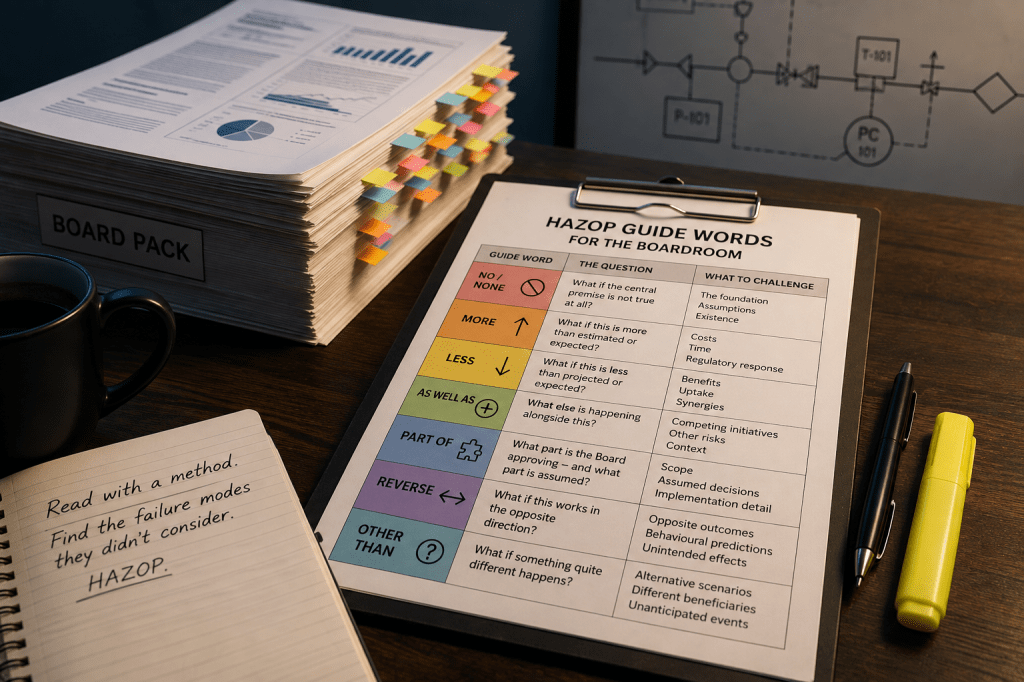
A board paper is, in a sense, a design. It proposes a course of action, sets out the reasoning, and relies on a set of assumptions the Board is being asked to accept. Reading it well means doing to it, in miniature, what a HAZOP team does to a process design. The guide words translate surprisingly cleanly:
- NO or NONE. What if the central premise is not true at all? What if the customer demand the strategy assumes does not exist? What if the cost saving the proposal relies on does not materialise? The discipline of the NONE question is to entertain, however briefly, the possibility that the paper’s foundation is wrong.
- MORE. What if the cost is higher than estimated? The timeline longer? The regulatory response more aggressive..? Most board papers contain implicit point estimates; the MORE question converts them into ranges.
- LESS. What if the benefit is smaller than projected? The take-up rate half what is assumed? The synergies slower to realise? LESS is the natural complement to MORE, and can be expected to be the more uncomfortable of the two.
- AS WELL AS. What is happening alongside the proposed action that the paper has not addressed? What other initiatives are competing for the same management attention? What other risks are accumulating in the background that this decision might exacerbate?
- PART OF. What part of the proposal is the Board being asked to approve, and what part is being smuggled through as implementation detail? This is, in my experience, the single most useful guide word in a governance context, because it surfaces the distinction between the decision the Board is being asked to make, and the decisions the paper assumes the Board has already made.
- REVERSE. What if this works in the opposite direction? What if the reorganisation reduces, rather than improves, productivity in the first year? What if the new pricing reduces, rather than increases, customer retention? Reversal questions can then be particularly useful for proposals whose case rests on a behavioural prediction.
- OTHER THAN. What if something quite different happens? What if the regulator focuses on a different aspect of the proposal than the paper anticipates? What if the principal beneficiary turns out not to be the group the paper identifies?
Every governance course tells directors to ask good questions, and every Chair worth their salt cultivates a culture in which questions are welcomed. The trouble is that “ask good questions” is an aspiration, not a method. Without a structured prompt, even experienced directors may tend to ask the questions their professional background equips them to ask – the lawyer asks about contractual risk, the accountant asks about the numbers, the marketer asks about the customer, and the engineer focusses on risk – and the questions that nobody’s professional background equips them to ask go unasked.
The discipline of running a quiet HAZOP over a board paper is that the guide words do not care about your professional background. NONE applies whether the paper is about a refinancing, a property acquisition, a service redesign, or a CEO succession. MORE and LESS apply to every quantitative claim. AS WELL AS forces the question of context. PART OF surfaces the smuggled assumptions. The method is what catches the failure modes that individual expertise misses.
I should clarify though that this technique is a habit of mind, not a procedure. When a paper recommends a course of action, run the guide words silently against the recommendation. When a paper presents a forecast, run them against the forecast. When a paper claims that a risk is mitigated, run them against the mitigation. The same discipline that makes me immediately ask “temperature, pressure, flow, composition” to flush out 80% of issues with a process engineering design in the first instance applies just the same with these HAZOP guide words and board papers.
The questions that emerge will be uneven – most guide words will not apply to a given situation, some will produce only trivial concerns – but the ones that do apply will tend to be the questions worth asking in the meeting. And over time, the discipline produces a particular kind of board contribution: the question that is not the obvious one, that the management team has not pre-rehearsed an answer to, and that on reflection turns out to be the question the Board should have been asking all along.
And that, at any rate, is what HAZOP is for. It works on pipes. And it works on board papers too.