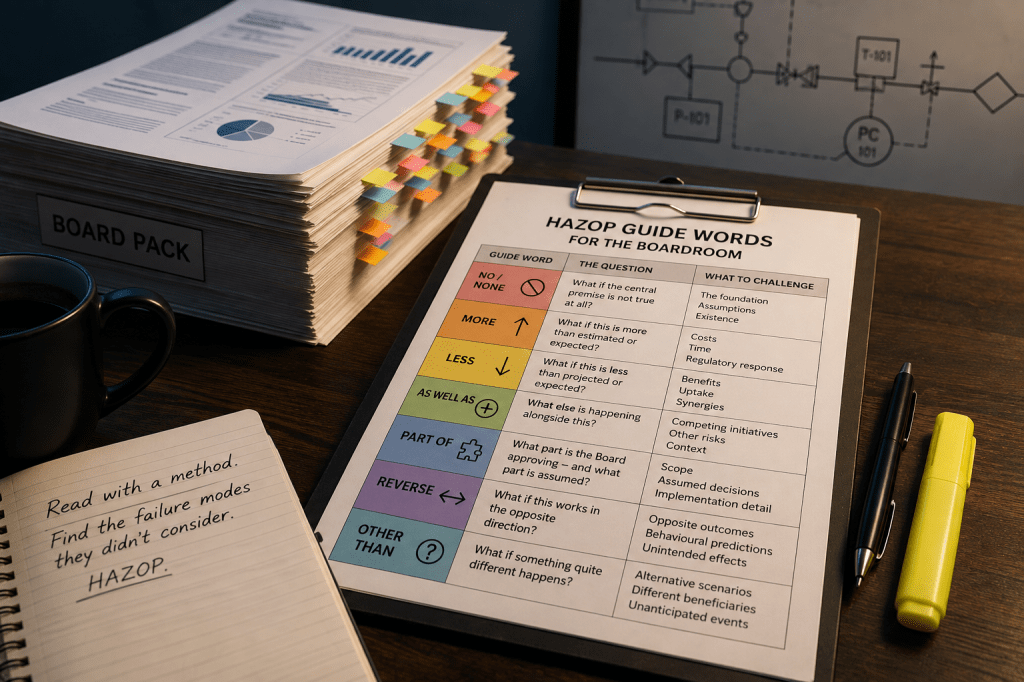

Any company worth their salt in energy and mining employ what the industry calls Stop-Work Authority. On a well-run hazardous facility, every person on site – the most senior project director, the newest contractor on their first morning, the cleaner emptying the bins in the control room – has the right to stop a job they believe is unsafe. The job stops. It does not stop subject to escalation; it does not stop pending a manager’s review; it stops. The supervisor’s role at that point is not to decide whether the stop was warranted but to investigate the concern, address it if the concern is valid, and explain the resolution to the person who raised it if it is not. The system protects the person who stopped the job – and protects them whether or not their concern turns out, on investigation, to have been correct.
The reason this works, when it works, is that the cost of unwarranted stoppages is treated as a price the organisation pays for the warranted ones, and the price is treated as cheap. A facility that loses two hours of production to a misjudged stop has lost two hours. A facility that fails to stop a job that should have been stopped has lost rather more than that – a product going off-spec, a loss of containment… a death. The asymmetry is so large that any system designed to optimise around it must err strongly on the side of empowering the stop.
I have been thinking about Stop-Work Authority in a governance context, because I think the boardroom has an equivalent; and the boardroom equivalent can be less developed than its industrial counterpart.
A director’s authority in a board meeting is, in formal terms, exercised through the vote. A director who believes a proposed decision is unwise votes against it. If the vote does not go their way, the decision proceeds, and the director’s options are to record their dissent, to escalate through whatever mechanisms the constitution and the Corps Act provide, or in extremis to resign.
But the formal vote is the wrong frame for what Stop-Work Authority actually offers. The right to vote against a decision presupposes that the decision is fully formed and ready for resolution. Stop-Work Authority, by contrast, is the right to interrupt the process before it reaches that point – to say, in effect, “before we proceed, I am not satisfied that we have done the work this decision requires, and I am asking that we stop until we have”. It is a procedural intervention, not a substantive one, and it is exercised earlier in the sequence than the vote.
In a well-run Board, this right exists informally. Any director can ask for a decision to be deferred. Any director can ask for additional information. Any director can ask for a matter to be referred to a committee, or for external advice to be obtained, or for the chief executive to come back to the next meeting with a revised proposal. These are the procedural levers that constitute the boardroom equivalent of Stop-Work Authority.
What may be variable is the culture around their use. On some Boards, asking for a deferral is treated as a routine and welcome contribution to robust decision-making. On others, it may be treated as obstructionism, as a failure to do the homework before the meeting, or as a personal slight to the management team that brought the paper. The formal right exists in both cases. The willingness to exercise it does not. But what then could erode a director’s willingness to interrupt a decision in progress?
- The first is time pressure, real or perceived. A Board running behind schedule on its agenda is a Board that punishes interventions, even where the Chair is conscientious about not doing so. The signal sent by the clock (we have three more items and forty minutes left) is heard, even when no one verbalises it.
- The second is the politics of the prior approval. When a paper has been worked through a sub-committee, endorsed by the Chair, and brought to the full Board on a recommendation, the procedural cost of stopping it rises sharply. Each prior layer of approval becomes part of the case for proceeding, and the dissenting director is implicitly disagreeing not just with the management team but with the colleagues who have already endorsed the proposal. Stopping the job, in this context, means stopping a job that several other people have already cleared.
- The third is the absence of structural permission. Industrial Stop-Work authority works because it is explicit: it is in the site induction; it is on every breakroom wall; there are scripts for invoking it. Boardrooms generally have none of this. The right to stop a decision exists in the constitution and in custom, but it is rarely articulated as an active expectation – and a director who has not been told that interruption is welcome may reasonably conclude that it is not.
- The fourth, and perhaps the most underestimated and most important, is the social cost of being wrong. A director who interrupts a decision and turns out, on investigation, to have been mistaken about the concern has paid a cost. The industrial response to this problem is to refuse to charge the cost – to treat unwarranted stops as a normal feature of a working system rather than as a failure of the person who stopped. Boardrooms should be doing the same.
The variable that does most of the work then to support these interventions will naturally be the Chair. A Chair who actively invites interruption – who makes it clear at the beginning of a difficult agenda item that any director may ask for a stop, and who treats such a stop as a contribution rather than an irritation – produces a different kind of meeting from a Chair who treats deferrals as setbacks.
The mechanics are not complicated. A Chair who, before a major decision, says something to the effect of “before we put this to the vote, is there any director who is not yet satisfied that we have done the work this decision requires?” is, in substance, opening the Stop-Work channel. A Chair who does not ask the question is leaving it closed. The same applies, with adjustments, to the Chair of any sub-committee, and to the CoSec, who is often the person best placed to flag procedural concerns, but who may be sometimes the most cautious about doing so.
The argument for taking Stop-Work Authority seriously in a governance context is strongest where the decisions being made are difficult to reverse and the consequences of getting them wrong fall on people other than the directors themselves. Commercial decisions made on behalf of shareholders can, in principle, be revisited if they prove wrong. Decisions made on behalf of beneficiaries who are not in the room (e.g. members of a superannuation fund, residents of an aged care facility, etc.) cannot be revisited in the same way. The cost of an unwarranted stop in the first context is borne by the organisation. The cost of a missed stop in the second context is borne by people who had no say in the decision.
The asymmetry, in other words, is the same asymmetry that motivates industrial Stop-Work Authority, and the Board’s institutional response should be similar: Make the right explicit. Make its exercise socially supported. Treat interruption as a feature of a healthy decision-making system rather than as a fault. And accept that the cost of the occasional unwarranted stop is the price of catching the warranted ones.
The unremarkable culture that allows anyone on a well-run industrial site to Stop Work without consequence is what governance should aspire to – at the level of the Board, on the most consequential decisions, every time.